Your Child Is Weak in Maths — 7 Signs It's Not Their Fault
Your child studies hard but still fails Maths tests? The problem isn't effort—here's what actually is.
Quick Answer
A child who studies but still scores badly in Maths is usually facing a structural gap, not a motivation problem. Seven signs point to this: recalling nothing under exam pressure despite understanding at home, needing a concept re-explained every time, avoiding word problems specifically, slow but accurate work, guessing patterns instead of solving, sudden refusal to attempt Maths homework, and scores that don't match effort. Each sign points to a specific, fixable cause — not laziness.
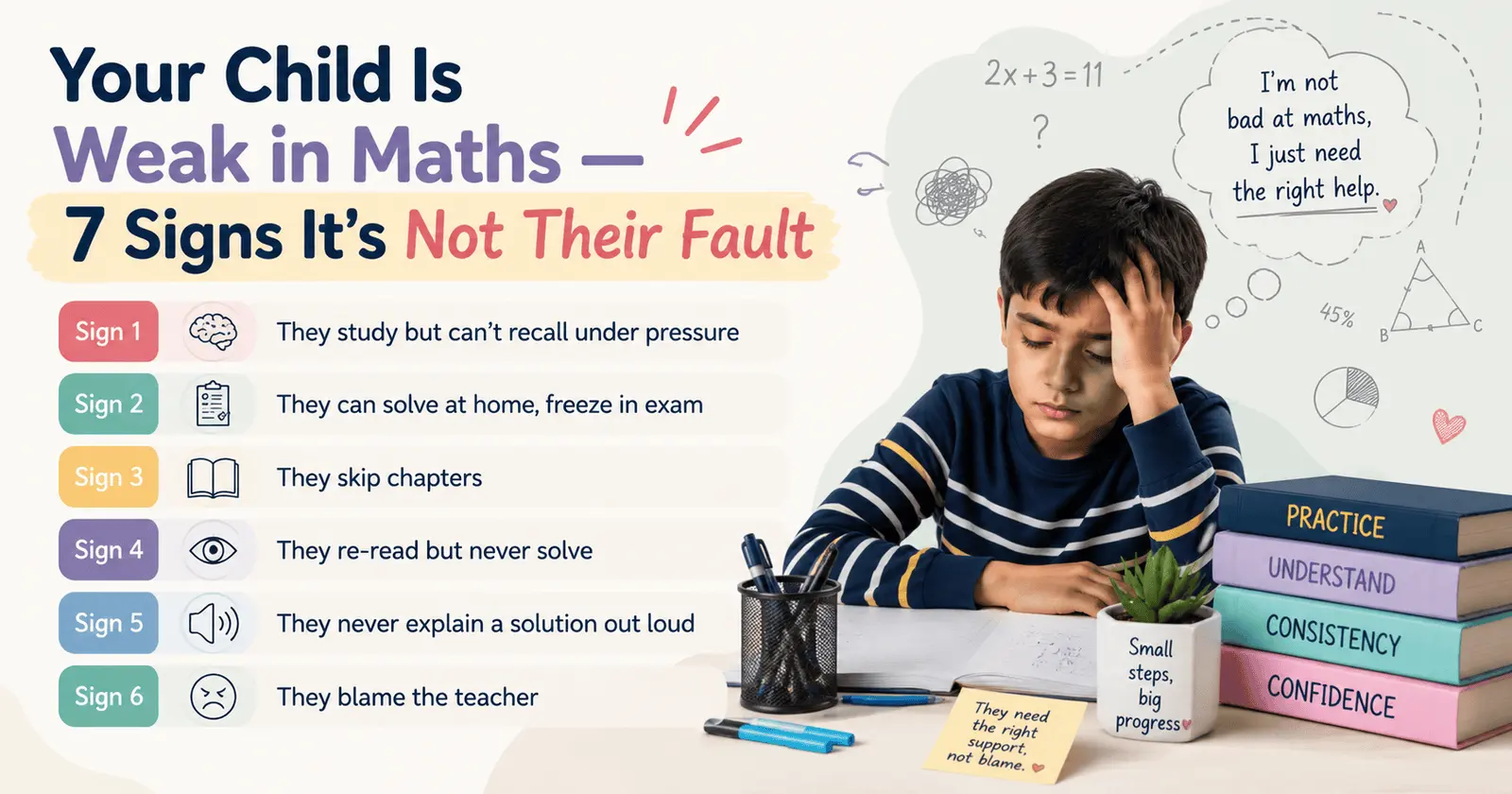
Before you tell your child to "study more", check for these 7 signs. If any of them describe your child, the problem isn't motivation — it's something you can actually fix.
Sign 1 — They study but can't recall under pressure
This is a memory/learning gap, not effort. Your child may understand a concept when you explain it or when they're relaxed at home, but the moment an exam starts, everything seems to vanish. This happens because they've learned passively — they've read notes or listened, but haven't encoded the information strongly enough for retrieval under stress. In CBSE Class 9 Maths, for example, a student might understand quadratic equations during revision but freeze when they see a slightly different variant in the exam. The fix: Use spaced repetition and retrieval practice. Ask them to solve the same problem type after 1 day, 3 days, then a week. This strengthens memory pathways.
Sign 2 — They can solve at home, freeze in exam
Anxiety, not skill. Treat the anxiety first. Home is a low-pressure environment with no time limits and instant help available. Exams are the opposite. If your child performs well at home but scores poorly in exams, exam anxiety is the culprit, not lack of knowledge. This is especially common in ICSE Class 10 Science practicals or time-bound Maths papers. The fix: Practice under exam-like conditions — same time limits, no interruptions, no access to solutions mid-attempt. Start with easier problems under pressure, then gradually increase difficulty.
Sign 3 — They skip chapters
Means the previous chapter is broken. Find the real gap. Maths and Science are sequential. If your child skips Chapter 5 because "they'll come back to it", but jumps to Chapter 6, they'll struggle because foundational concepts are missing. For instance, in CBSE Class 8 Maths, if they don't master linear equations, they'll suffer in Chapter 9 (Linear Equations in Two Variables). The fix: Do a diagnostic test on prerequisites. Ask them to solve 5 problems from the "skipped" chapter. Their errors will reveal the exact gap.
Sign 4 — They re-read but never solve
Passive learning. The fix is active recall — close the book, attempt. Re-reading creates a false sense of familiarity. Your child thinks they know it because they've seen it, but they haven't produced the knowledge. In Class 9 Science, simply reading the chapter on photosynthesis won't help — they need to draw diagrams, label parts, and explain the light and dark reactions without the textbook open.
Sign 5 — They never explain a solution out loud
If they can't explain, they don't understand. Make them teach you. Ask your child to walk you through a solved problem, step-by-step, as if you're a peer who doesn't know the answer. When they struggle to explain why a step is necessary, you've found the conceptual gap. This is invaluable in subjects like ICSE Class 10 Chemistry, where understanding why hydrogen burns with a pop sound (oxygen is present) is different from memorizing that it does.
Sign 6 — They blame the teacher
Common deflection of "I don't get it". Don't argue — diagnose. Blaming the teacher is often a defense mechanism masking confusion. Instead of debating teaching quality, ask open-ended questions: "Show me what part confused you?" or "What would make this clearer?" This shifts from blame to problem-solving.
Sign 7 — Tuition isn't helping
Group tuition can't fix individual gaps. You need 1-on-1 attention. If your child has attended tuition for 2+ months without visible improvement, the tutor may be teaching the class as a whole, not addressing your child's specific misconception. A student weak in CBSE Class 10 Maths quadratic equations might need 5 focused sessions, not generic group revision.
The Practical Takeaway
Start with diagnostic conversations, not more study hours. Ask your child to solve one problem and narrate their thinking aloud. Listen for where they hesitate, make assumptions, or skip steps. That's your starting point. Once you've identified whether the gap is conceptual, procedural, or anxiety-driven, you can choose the right intervention — whether that's revisiting prerequisites, practicing under pressure, or seeking specialized tutoring.
Related reading
- Does Your Child Understand Maths or Just Memorise? — three quick questions that reveal understanding versus memorising
We've now published the complete CBSE Class 10 Maths Exam Preparation Guide that ties everything on this blog together.
Ready to try it yourself? Practice CBSE Class 8–10 Maths and Science with step-by-step AI tutoring — start a free session on Classmate AI.
Frequently asked questions
What are the signs that a child's weakness in Maths is due to a knowledge gap rather than lack of effort?
The clearest sign is inconsistency — a child who performs well on familiar question formats but fails on the same concept presented differently has a foundational gap, not a motivation problem. Other signs include declining scores specifically when chapters build on earlier topics (e.g., Algebra in Class 9 building on Class 8 Linear Equations), while performance stays stable in non-cumulative subjects. Effort alone doesn't fix an unidentified gap.Why does a child who studies hard for Maths still score poorly in CBSE exams?
Hard study without targeted practice on weak concepts produces diminishing returns — a student re-reading solved examples doesn't encounter the specific variation they'll face in the exam. CBSE Class 10 papers, particularly in Algebra and Geometry, test concept application rather than procedure recall, so high study hours spent on the wrong activity (re-reading vs. attempting unseen problems) doesn't translate into marks.How do foundational gaps from Class 7 or 8 affect a student's CBSE Class 10 Maths performance?
CBSE Maths is cumulative — Class 10 chapters like Quadratic Equations, Trigonometry, and Coordinate Geometry directly build on concepts introduced in Class 7-8. A student with unresolved gaps in basic Algebra or Geometry from earlier grades typically hits a compounding difficulty curve by Class 9-10, where each new chapter feels disproportionately hard because the prerequisite understanding was never secured.Can exam anxiety cause a child to perform worse in Maths than their actual ability level?
Yes — exam anxiety specifically impairs working memory, which Maths relies on more than most subjects because multi-step problems require holding intermediate results in mind while computing the next step. A student who solves problems correctly at home but blanks during timed tests is often experiencing genuine cognitive interference from anxiety, not carelessness. This is a documented pattern in academic performance research and distinct from a knowledge gap.As a parent, how do I know if my child needs a different teaching method rather than more study hours?
The signal is whether increasing study time has produced any measurable improvement over 4-6 weeks — if accuracy on the same question types isn't improving despite more hours, the method isn't working, not the student. A different approach (guided questioning instead of direct instruction, visual methods for Geometry, AI-based adaptive practice for Algebra) often produces faster gains than continuing the same method with higher intensity.Is it true that some children are just "not Maths people" and will always struggle regardless of teaching quality?
This is a misconception not supported by learning research — mathematical ability is not a fixed trait, and the majority of CBSE Maths struggle at Class 8-10 level is attributable to specific, identifiable gaps rather than innate incapacity. Studies on growth mindset and adaptive teaching consistently show that students labeled "not Maths people" improve significantly when instruction matches their specific gap rather than their perceived ability ceiling.
Start learning with Classmate AI
Free to start · No credit card · Works for Class 8, 9 and 10 CBSE & ICSE
Get started free →