Does Your Child Understand Maths or Just Memorise?
Stop guessing. These 3 simple questions reveal whether your child actually understands or just memorises.
Quick Answer
To tell whether a child understands a Maths concept or just memorised it, ask them to teach it back in their own words, explain why a formula works (not just state it), or solve a slightly different version of a problem they just did. A child who understands can do all three without opening the book; a child who memorised will recite verbatim, freeze, or say "I don't know how to explain it."
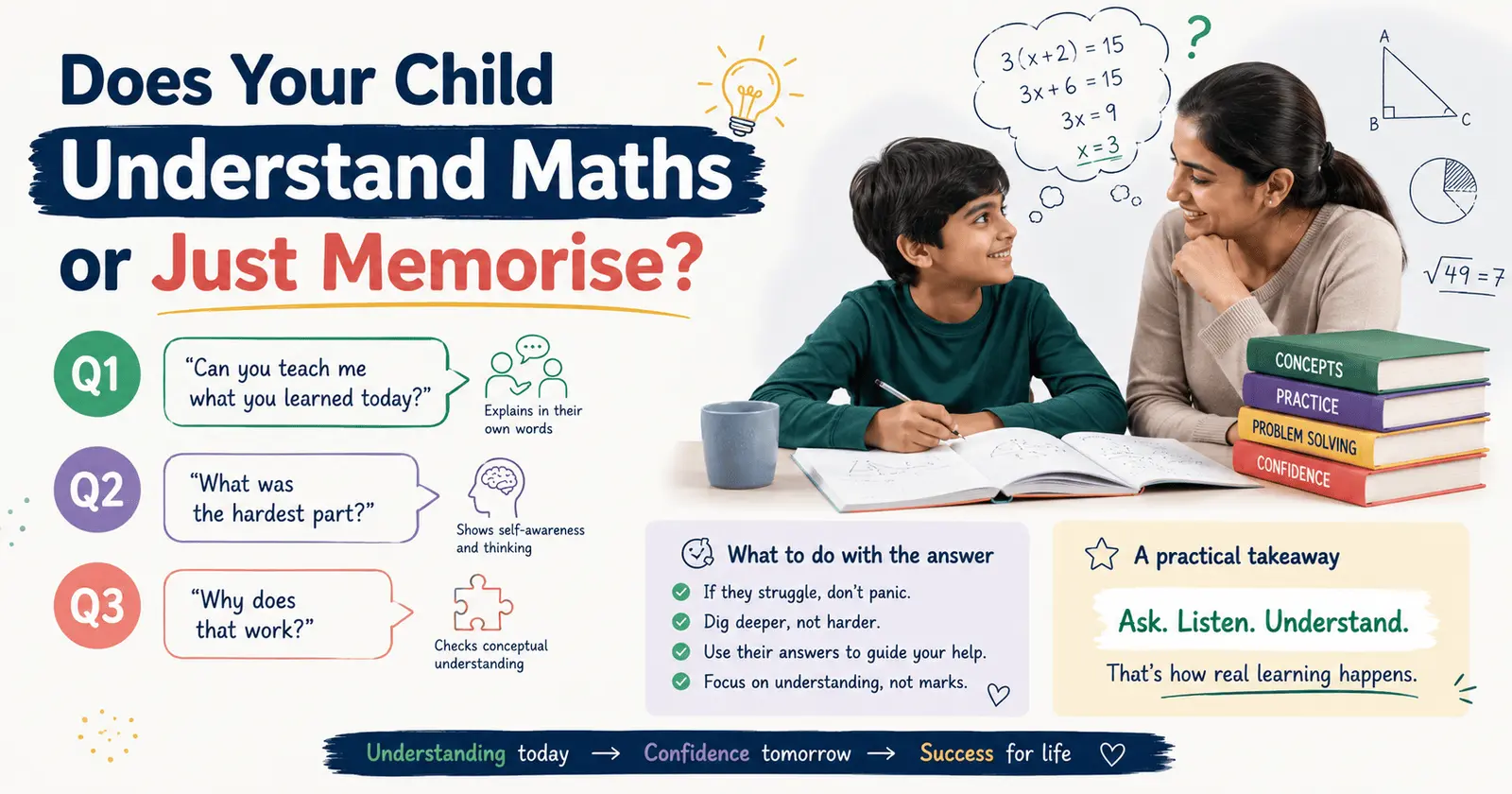
Your child says "I understand". The report card says otherwise. Here are 3 dinner-table questions that reveal the truth — without making them feel tested.
Question 1 — "Can you teach me what you learned today?"
If they can teach it in their own words, they get it. If they freeze or open the book, they were memorising.
This works because teaching forces your child to reconstruct knowledge from first principles. For example, if they learned about algebraic identities in Class 8, a child who truly understands can explain why $(a+b)^2 = a^2 + 2ab + b^2$ using a visual (like a square divided into parts) or a story. A memoriser will either recite the formula verbatim or say "I don't know how to explain it."
The same applies to photosynthesis in Science — a student who understands can walk you through why plants need sunlight, water, and CO₂, and what they produce. A memoriser lists steps without connecting them.
Question 2 — "What was the hardest part?"
A student who really understands knows where the difficulty is. A memoriser says "all of it" or "nothing".
This question reveals whether they've actually engaged with the material. When learning linear equations in two variables (Class 9), a student who understands might say: "I get how to plot points, but finding the equation from a graph took me time." That's honest struggle with a real concept.
By contrast, a memoriser either dismisses everything as hard (because nothing stuck) or claims nothing was hard (because they just copied notes). Neither response shows genuine engagement with the problem.
Question 3 — "Why does that work?"
Asking why a formula works (not how to use it) separates surface knowledge from real understanding.
This is the deepest question. For instance, in Pythagoras' Theorem, asking "Why is $a^2 + b^2 = c^2$?" is different from "How do I find the hypotenuse?" A child who understands can show you visually (using area diagrams) or logically why the relationship holds. They might even connect it to distance calculations or real-world problems.
In Science, if they learned about speed, distance, and time, asking "Why do we divide distance by time?" forces them to think about what speed means — not just plug numbers into a formula. Understanding students often say things like: "Because speed tells us how far we go in one unit of time." Memorisers repeat the definition from the textbook without clarity.
What to do with the answer
If they pass all 3 — they're fine. If they freeze on 2+, the gap is real. Don't punish — re-teach.
When you spot a gap, use these strategies:
- Ask more questions instead of explaining — guide them to rediscover the concept
- Use real objects — algebra tiles for equations, water and a plant for photosynthesis
- Connect to something they already know — relate new topics to previous chapters or daily life
A practical takeaway
Have this conversation once a week, not as an interrogation but as genuine curiosity. You'll notice patterns: which topics stick, which ones need a revisit, and whether your child is building confidence or hiding confusion.
The goal isn't to test them — it's to see what's actually happening in their head. Real understanding shows itself in clarity, examples, and honest struggle. Memorisation shows itself in silence, scrambling for notes, or robot-like recitation.
Related reading
- Why Your Child Says "I Studied Everything" But Still Scores Badly — the study-habit fix for "I studied everything but still failed"
We've now published the complete CBSE Class 10 Maths Exam Preparation Guide that ties everything on this blog together.
Ready to try it yourself? Practice CBSE Class 8–10 Maths and Science with step-by-step AI tutoring — start a free session on Classmate AI.
Frequently asked questions
What is the difference between a child memorising Maths and actually understanding it?
A child who has memorised Maths can reproduce a formula or method they've seen before but fails when the same concept appears in a new format or word problem. A child who understands Maths can identify why a method works and adapt it to an unfamiliar question. CBSE Class 9-10 papers increasingly use case-study and application formats specifically designed to distinguish between these two.How can I tell if my child understands a Maths concept or has just memorised the steps?
Ask them to explain a recently solved problem using different numbers or a slightly changed condition — a child who understood the method can adapt it, while one who memorised steps will get stuck or produce the wrong answer. This "variation test" works reliably across CBSE topics like Trigonometry identities or Algebra — same concept, different surface, immediately reveals which type of learning occurred.Why does my child score well in class tests but poorly in CBSE board-style or application questions?
This gap almost always indicates memorisation rather than understanding — class tests often repeat familiar formats students can pattern-match, while CBSE board papers and sample papers introduce the same concept through unfamiliar question structures that require genuine reasoning. A student scoring 85% on chapter tests but dropping to 55% on sample papers is showing a classic memorisation-vs-understanding gap, not a revision gap.What type of Maths questions on the CBSE board exam specifically test understanding rather than memorisation?
Case-study based questions (introduced in CBSE Class 10 from 2020 onwards), competency-based questions, and multi-step word problems in Algebra, Statistics, and Mensuration are designed specifically to test application of concepts rather than recalled procedures. A student who has only memorised standard NCERT solutions will struggle with these question types even with full syllabus coverage, since they require reasoning beyond the textbook template.As a parent with no Maths background, how do I check if my child genuinely understands a topic without being able to solve it myself?
Ask your child to teach the concept back to you in plain language — if they can explain why a step is done (not just what the step is) without using textbook phrasing, they understand it. Parents don't need subject knowledge to run this check; the test is whether the explanation makes logical sense to a non-expert, which requires understanding, not memorisation.Is it true that students who memorise well will eventually "naturally" develop understanding over time without any intervention?
This is a misconception — memorisation and understanding are built through different cognitive processes, and one does not automatically convert into the other. A student who memorises CBSE Maths methods for three years without being asked to reason through why they work typically reaches Class 10 with larger gaps, not smaller ones, because higher-grade topics build on conceptual foundations the memorisation approach never established.
Start learning with Classmate AI
Free to start · No credit card · Works for Class 8, 9 and 10 CBSE & ICSE
Get started free →