What Parents Should Know About AI Tutors for CBSE Class 8–10
Stop guessing. Learn what AI tutors actually do—and what they don't—before you invest.
Quick Answer
An AI tutor for CBSE Class 8-10 is software designed to hold a learning conversation, not just deliver content — it asks questions, gives hints instead of answers, checks work, and explains concepts, adapting to how a specific child thinks. It's available 24/7, unlike a scheduled tutor slot, and typically costs a fraction of private coaching. It's strongest for unlimited practice and instant doubt-solving, weaker at reading emotional cues a human notices instantly.
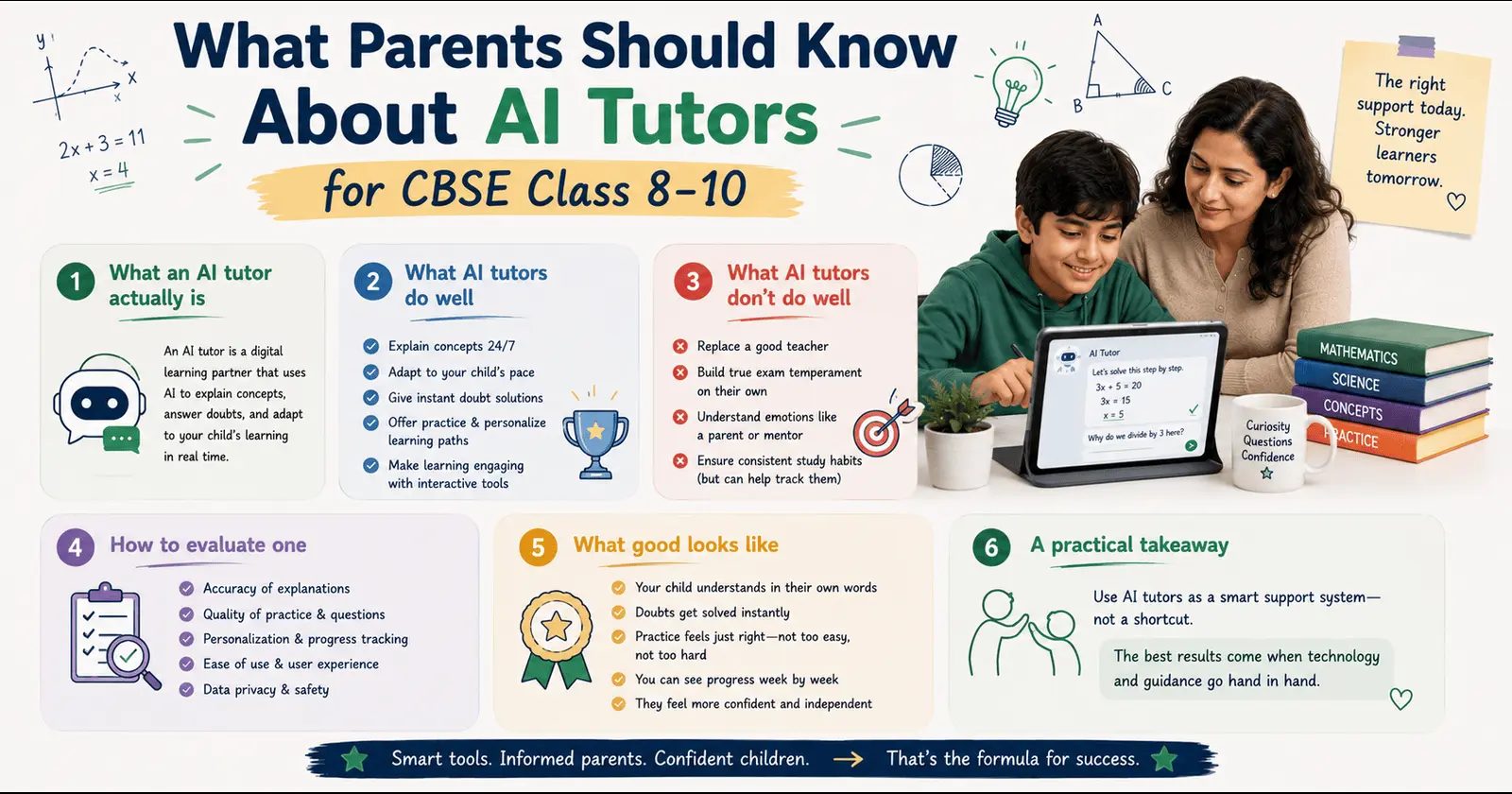
AI tutors are becoming more common, but most parents have heard of them without fully understanding how they work or whether they're worth the investment. Here's a practical, no-jargon guide to help you decide if an AI tutor is right for your child.
What an AI tutor actually is
An AI tutor is a computer programme designed to have a learning conversation with your child—not just deliver content. It asks questions, provides hints when your child is stuck, checks their work, and explains concepts. Unlike video lectures or answer-key websites, a good AI tutor adapts to how your child thinks and learns. It's available 24/7, so your child can ask for help at 10 PM the night before an exam or while doing homework on a Sunday.
What AI tutors do well
Patient explanation. An AI tutor won't sigh or rush. If your child asks the same question five times, it answers five times without frustration.
Unlimited practice. Unlike a human tutor who charges per hour, an AI tutor can generate countless practice problems. For CBSE Class 9 Maths, for example, it can create variations of quadratic equation problems until your child truly masters the concept—not just memorises the method.
Doesn't get tired. It works at your child's pace, whether they're a slow learner who needs repetition or a quick learner who wants to sprint ahead.
Tracks weak topics. Good AI tutors log which concepts your child struggles with—say, "probability" in Class 10 or "photosynthesis" in Class 8 Science—and flag these for revision.
What AI tutors don't do well
Emotional support. If your child is anxious about exams or demotivated, an AI tutor won't notice or care. It can't build a human relationship.
Reading social cues. A human teacher sees that a student is lost and simplifies the explanation. An AI might not.
Replacing great teachers in essay-based subjects. History, English literature, and subjects requiring debate benefit from human judgment and nuance. An AI tutor works best for Maths and Science, where answers are more objective.
How to evaluate one
When you're comparing AI tutors, ask these three questions:
(1) Does it ask questions or just give answers? A weak AI tutor shows your child the solution immediately. A strong one asks, "What's the first step to solve this equation?" and guides them to find the answer themselves.
(2) Does it track progress? Can you (the parent) see a report showing that your child has worked on 12 algebra problems this week and got 10 correct? Tracking matters because it shows what's actually happening.
(3) Does it give parents visibility? You should be able to log in and see your child's activity, strengths, and gaps. Transparency helps you stay involved without hovering.
What good looks like
A high-quality AI tutor follows the Socratic method: it says "What do you think?" before giving the answer.
For example, if your Class 9 child asks, "How do I solve 3x + 5 = 20?", a good AI tutor doesn't immediately say, "Subtract 5 from both sides." Instead, it asks, "If you have 3x + 5 and the answer is 20, what do you need to do to get 3x alone?" Your child thinks, tries, and learns. That's the difference between a tutoring tool and a homework cheat.
A practical takeaway
Use an AI tutor as a supplement, not a replacement. It's perfect for practice, revision, and explaining concepts your child didn't grasp in class. But it works best when paired with a human teacher (or you) who can motivate your child and connect learning to the bigger picture. Start with a free trial if available, and observe whether your child is thinking critically or just copying answers.
Related reading
- Your Child Is Weak in Maths — 7 Signs It's Not Their Fault — signs it's a real gap, not a motivation problem
We've now published the complete CBSE Class 10 Maths Exam Preparation Guide that ties everything on this blog together.
Ready to try it yourself? Practice CBSE Class 8–10 Maths and Science with step-by-step AI tutoring — start a free session on Classmate AI.
Frequently asked questions
What exactly is an AI tutor, and how is it different from a learning app or YouTube videos?
An AI tutor is interactive — it asks questions, evaluates a student's specific answer, and adapts the next question based on where they went wrong, unlike YouTube videos or static learning apps that deliver the same content to everyone regardless of performance. For CBSE Class 8-10 students, this means an AI tutor can target a child's specific weak chapter (say, Mensuration) rather than making them sit through an entire generic video series.Is it safe for my child's data if they use an AI tutor for CBSE Maths or Science?
Safety depends entirely on the specific platform's data policy, so parents should check whether the AI tutor stores a child's personal data, how long it's retained, and whether it's shared with third parties for advertising. Under India's Digital Personal Data Protection Act, platforms handling minors' data are required to get verifiable parental consent — parents should confirm this exists before signing up, not assume it by default.How much daily screen time on an AI tutor app is reasonable for a CBSE Class 8–10 student?
Most pediatric and educational guidance suggests 30-45 minutes of focused AI-tutor use per subject session is more effective than longer unstructured screen time, since attention quality drops sharply after that window for school-age students. For exam-heavy periods, this can extend to 60-90 minutes total across subjects, but should be split into sessions rather than one continuous block to avoid fatigue-driven errors.Can an AI tutor actually prepare a Class 10 CBSE student for board exam-style questions, or only basic practice?
A well-designed AI tutor can handle CBSE board exam-style questions, including application-based and case-study formats introduced in recent CBSE papers, not just basic drill questions — but this depends on whether the platform is updated to the current CBSE syllabus and question pattern. Parents should verify the tool explicitly references current CBSE marking schemes rather than generic international Maths content before relying on it for board prep.How do I know if an AI tutor is actually helping my child's exam preparation, or just keeping them occupied?
Check whether the platform provides specific, topic-level progress reports (e.g., "weak in Quadratic Equations") rather than vague overall scores or time-spent metrics, since time spent doesn't indicate learning. A useful signal is whether your child's accuracy on a previously weak topic improves over 2-3 weeks of practice — if there's no measurable shift, the tool isn't being used effectively or isn't suited to their gap.Is it true that AI tutors only work for self-motivated students and are useless for students who struggle with discipline?
This is a partial misconception — AI tutors with built-in reminders, streaks, or scheduled sessions can support lower-discipline students, but only if a parent or teacher sets up the routine initially, since the AI itself doesn't enforce consistency the way a scheduled human tuition slot does. Students who struggle most with self-direction typically need a parent to set fixed AI-tutor session times, not the tool alone.
Start learning with Classmate AI
Free to start · No credit card · Works for Class 8, 9 and 10 CBSE & ICSE
Get started free →